|
SECRET OF THE COLOURS
Catalogue text on the works of K.u.B.O, August 2008
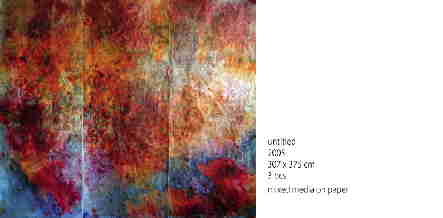
Thick clouds of vibrant orange sweep from the top left of the picture across its entire surface and seemingly beyond, billowing up, thickening, before wafting away over a warm orange shade of yellow.Darker, shadowy spots crowd together, forming focal points at the upper and left-hand edges of the picture and dispersing individually into mauvish pink hues as they fall. Rather than creating a monochrome expanse, this in turn hangs like a mist over a blue ribbon that dominates the lower section of the picture. In direct contrast to the orange, these alternating light and dark shades of blue enhance the tension between the two sections of the picture. With irregular contours and overlaid by different shades of orange, the blueness edges right across the lower part of the picture. It delimits the orange making its way downward from the upper border of the image, partly blending with it whilst forming a definite dividing line to the orange of the lower right-hand edge, which in turn is making its way upward. The latter is afforded very little space, and yet, thanks to the strength conveyed by the extremely rich and bold colour scheme, it allows form and colour to provide a genuine contrast to the upper sea of colour that takes up virtually the entire pictorial space.
Three lengths of paper, equal in width and 3 m high, fall into place to form this large landscape-format picture. The light and shade effects from the crumpled sections that have been worked crosswise and lengthwise into the background conjure up a high degree of animation and vitality. Even though the colour composition is entirely abstract, the viewer can’t help but make associations with a map on which a narrow ribbon of sea, a gulf, crosses the piece of land depicted. The eye is automatically drawn into the image, captured inextricably by the intensity of colour, a fiery, vibrant orange: layer upon layer of colour, with recurrent instances of clear glaze to suggest spatial depth and allow a view of things. These glazes ultimately overlay the picture with the merest hint of golden lustre, strengthening the impression of magnitude, monumentalism, and secrecy, too.
It is the colour itself that, through its composition and vibrancy, becomes the picture’s vehicle of expression. It is this colour and its essential pigments, somewhat strange and unfamiliar to those of us who live north of the Alps, that give us a small insight into the fascination of foreign lands.
This large-format work not only calls for a high, long wall, but also needs a spacious room that gives it air to breathe and unfold, allowing it to display light and luminosity and, conversely, be viewed at leisure.
None of K.u.B.O’s works are the kind to unlock their secrets at a fleeting glance. In each case it is first and foremost the colour that tempts one to look CLOSELY. By inviting the viewer to submerge themselves in a sea of colour, the images create new insights as they unfurl to reveal heights and depths, and a two-dimensionality that makes them into “walk-in” images.
As well as the large-format, often tripartite pictures, there are single sheets and also bipartite paintings, conceived as diptychs. Abstract shapes and figures are aligned with each other across both halves of the picture, connecting and uniting in the middle, pointing towards a common centre.
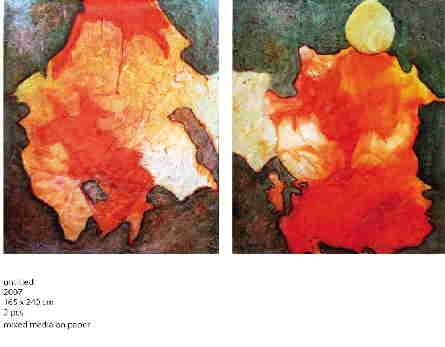
Such is the case in Picture
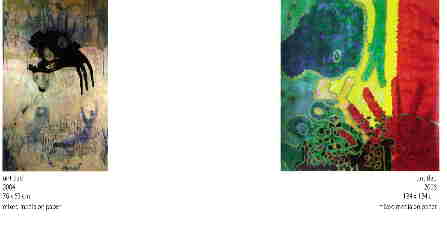
Here, each half of the picture is dominated by a large abstract figure. They rise up from the blue-green background in hues of rich orange, and their sharply defined contours lend them strength of expression. The fiery colour spills over interior, drying into droplets and bleeding into channels. The left-hand section shows a fish-like creature engaging in a headlong, twisting motion, the direction of its plunging body established by a square aperture at what is conceivably the head. This aperture within the figure takes up the colour of the background, references it and ensures that the link with the rearward section is preserved. This creates space in the front part of the picture, which appears to magnify the figure on the right-hand side of the diptych. Despite there being no indication that it is a human being, one gets this impression thanks to the crowning oval form reminiscent of a face looking back. The robes swathing its body billow out and demand space, underscoring this impression through the blatant swirl of colour about its own axis.
The link between the two figures is constituted by the geometric shape at the centre of the picture, which catches the viewer’s eye by virtue of its form and very bright orange colour scheme. Yet in addition to bringing and holding together the two visual elements, it’s function is to devise a background, middleground and foreground, an absolutely vital compositional effect that helps to create a sense of space.
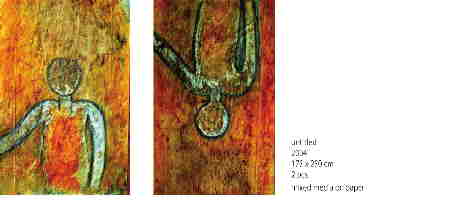
Besides these abstract visual themes, there are a few works by K.u.B.O. that take people as their main subject. Pared down to the minimum and yet readily recognisable, they show the physiognomy of a human being. With the head, neck, upper torso and arms all drawn virtually in a single stroke the person becomes an interchangeable entity, empty on the inside and only brought to life by absorbing the colour of the background. In the diptych,
each half of the picture features the same motif of two sketched human bodies, rendered almost identically up to hip level. One arm dangles at ease next to the rump, while the other is raised in a gesture of greeting or touching the next person. When the two halves of the image are placed with each dangling arm pointing towards the centre, the viewer is directly confronted with the idea of the ‘cold shoulder’, of rejection, possible alienation, at the very least ‘foreignness’. If, however, the slightly elevated arms point towards the middle, then the picture instead conveys a notion of reaching out and shaking hands, and, despite all uncertainty, that of hope in an indeterminate world.
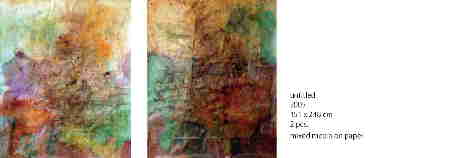
Less clear, and yet perceptible upon lengthier examination, is the face of a human being in the background of Work
With closed eyes – dreaming, perhaps slumbering, meditating in a quiet spot – such is the impression of this face, which emerges but allusively from behind a layer of lightly glazed pastel shades. Here, besides hues of orange and brown, shades of purple and green suggest an out-of-focus landscape photo. Behind this landscape shimmers the outline that describes one third of each respective half of the diptych. In the middle of this face, at the central point of the picture, there also emerges a circular swirl of greenish purple. This gives rise to the impression of a colossal nose, reminiscent of a clown: at first only vague and indeterminate, but then – hey presto, no longer to be ignored. Calm, introverted, no simpleton making fun, but – if one engages with this gaze – a horizontal line seems to appear beneath the swirl, the ends of which point downwards, lending the face a certain air of completeness.
In this work again, the strength of expression and the suspense of what is being related are created by two equally strong, richly worked sheets, joined at the verticals. But those pictures that are conceived as individual sheets, mostly in a large format and never less than 120 cm, also manifest an inner coherence and harmony.
In all his pictures, K.u.B.O. generates highly luminous, mostly abstract colour compositions with echoes of living creatures. The nature of the colour pigments used is responsible for the way in which these colour compositions captivate the viewer. They allow us to find and discover things, inviting the viewer’s gaze to wander through the picture.
His capacity for artistic expression, for lending form to the things around him and eliciting from them what he sees within is what characterises his way of creating art. For instance, K.u.B.O. applies himself to a number of activities with the same intensity that he devotes to painting. His work with wood and photography deserve a particular mention here.
Pieces of wood are collected - tree stumps, old branches that have long since fallen from a living tree - each harbouring their own secret, subsequently to be hollowed out, carved, and conjured forth by his hands. This generally culminates in faces, often comprised merely of eyes and a mouth, behind which lies a story. The grain of the wood underscores the strength of expression.
Likewise the camera, a technical device, designed to copy images of reality, produces a reality in light and shade, readily apparent to the human eye, despite the frequent choice of less everyday subjects. In. K.u.B.O.’s case, the actual process by which the photograph is created is of the essence. Long exposure times, superimposition, distortion and colour shifts make his photos what they are: each remains a snapshot, free from any technical modification at the hands of a computer, no touching up or idealisation.
It is also the case with his painting that the snapshot determines the expressive quality of his pictures, unbridled momentum rather than a painstaking process. The painting of K.u.B.O. moves in the sphere of absolute abstraction, and this is how the viewer experiences it at their first fleeting glance of such richly coloured images. The paint is applied with great verve, hurled, shaken, rubbed, sprayed onto, across and around the paper using brushes, sponges, paper, fabric, and even the hands.
This gives rise to colour compositions that are brought to life via every kind of pigment – each virtuoso in its own right. The paint often appears to sprawl across the background in great plumes of colour, overlaid by new layers that blend with or repel those underneath, forming large and small droplets, culminating in the finest mist. And then again, one finds pictures in delicate, flowing colours, transparent, with the finest of nuances. Light-coloured glazes similarly cloak gently shimmering, slightly richer and darker swathes of colour that seem to rise up from the background.
Light and shade become entangled in the structure of the paper, which is not stretched smoothly, but gathered, pleated, crushed and smoothed out again. The artist always uses white watercolour paper, metres of it taken from the roll, preferably in large format. And there the colour leaves its mark. The moisture dries in the depressions created, and, by adding coarsely grained powder, the process is deliberately drawn out to produce new effects.
Being called upon to look closely, the viewer is then able to make out figurations that gradually take shape from the abstraction. These squirming figures, always sharply defined, tend to seem like a distant reminder of primordial forms of life. Only rarely are they recognisable as human beings, although personification never enters into it.
Superimposing individual layers of colour against what is not always an unmistakable background is a fundamental design principle found in the works of K.u.B.O. The very bottom layer often remains visible, being allowed to surface as a result of rubbing and dabbing away surplus paint moisture, and given a new transparent coat of paint that captures the genesis. Or else he will use the individually applied layers for new effects, shedding different degrees of light on the colours, making them appear changeable, impenetrable, as if under seal. Only the relief-like structures point to the actual work process.
The fascinating luminosity of these pictures comes from his handling of colour, his use of pure and specially selected pigments sourced from all over the world which he mixes according to his own formula and applies in different layers, their changing surfaces amplified by the varying incidence of light. A hint of gold or the occasional gleam of silver, which makes the picture seem more precious still and fabulously ethereal, adds the final touch.
These pictures tell us about the painter’s very being, his life between two worlds, between East and West; they are possibly even the resume of his influences and experiences, of the link between his life in Asia and in Western Europe, where his own roots lie.
And so the painting of K.u.B.O. centres around and thrives on the secret of colours and his discovery of the rich hues of Asia.
Dr.Annette Werntze, August 2008
More infos about KuBOs paintings under www.kubo.hk
|